Armed unrest in the Comala region
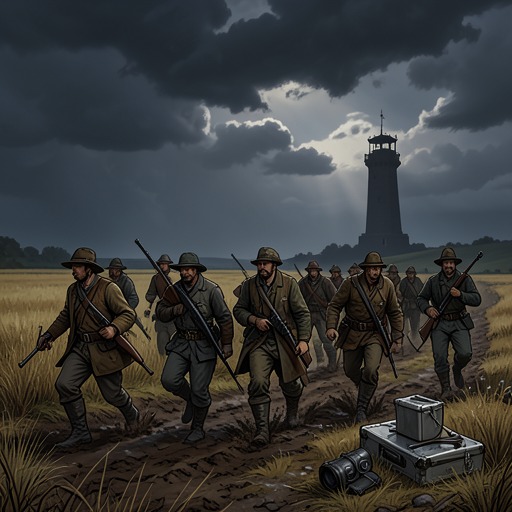
Pedro PáramoArmed unrest in the Comala region is not a clean break from the local order but a struggle conducted within and against Pedro Páramo’s power. Land seizures, manipulated legal claims, and control of the estate’s resources precede the revolutionary challenge; when armed opposition reaches Comala, Pedro attempts to turn it into another bargain. Later reports of shifting allegiances and the priest Rentería’s taking up arms show a conflict in which political loyalties remain unstable even as the region’s ordinary people bear the consequences.
The estate’s order before revolt
The conditions surrounding the unrest are visible in Pedro’s dealings with land and debt. When Fulgor Sedano presents the estate’s failing finances, he reports that its last cattle have been sold. Pedro’s response is not to settle accounts evenly: he identifies the Preciados as the first creditors to be paid, while the family has received less than others and is owed the most. He directs Fulgor to seek Dolores Preciado’s hand, explicitly linking marriage to the money and property he wants to secure. The episode makes economic dependence part of the same system as personal authority.
The dispute with Toribio Aldrete shows how that authority bears on land claims. Aldrete has measured a boundary and asks that the missing section of fence be built. Pedro instead declares that the boundary can wait, insists there will be no enclosures, and later orders Fulgor to tell Aldrete that the fences must be returned to their former positions because Aldrete is supposedly encroaching on Media Luna land. The measurements are not the deciding factor: Pedro instructs his agent to contradict them and, if necessary, demolish the fences.
Fulgor’s formal complaint against Aldrete uses the language of usufruct, but Aldrete dismisses the accusation as a pretext and ridicules the paper. His response exposes the gap between legal form and the power that determines what happens on the ground. Pedro makes that gap explicit when Fulgor asks about the law: Pedro says that they will make the law themselves. He directs Fulgor to find men willing to visit Aldrete and to bring a complaint on any charge that will serve. The ensuing threat is therefore not simply a land dispute; it is a demonstration that Pedro can enlist both paperwork and intimidation to make his own claim prevail.
Estate resources and coercive reach
Pedro’s control is also material and logistical. In a heavy rain, the great gate of Media Luna opens to a long procession of mounted men, continuing as far as the two-hundredth rider. Fulgor directs them to move the cattle from Enmedio beyond the former Estagua and to drive Estagua’s cattle toward the heights of Vilmayo before the rains arrive. This is an organized redistribution of livestock and movement across the countryside, not an explicitly identified rebel deployment. Its significance lies in the scale of the estate’s reach: orders from the ranch can mobilize men and redirect herds across several named places.
That reach shapes Pedro’s posture when armed rebels confront him. One of them denounces both the government and Pedro, accusing him of being a bandit and a thief, and says that the governor will be answered with gunfire. Pedro does not answer the accusation by defending his rule or renouncing it. Instead, he asks how much the revolution will cost and offers that he might help. The rebels’ reply treats a wealthy ally as a practical resource, even after one speaker has condemned Pedro. Their exchange turns revolutionary purpose into a negotiation over money and support, revealing how opposition to a corrupt order can still depend on the resources of a powerful local landowner.
Shifting allegiances and armed authority
The unrest does not settle into a stable alliance. The Boa repeatedly returns with news that his men have joined first Venustiano Carranzo’s side and then Álvaro Obregón’s. Pedro answers these changes with brief approval rather than demanding a consistent political commitment. When the Boa reports that peace has been made and his men are idle, Pedro tells him not to disarm because the calm will not last. The exchange presents armed readiness as an ongoing condition: a lull is not a resolution, and the men’s political affiliation can change without dissolving their usefulness as a force.
A new complication arises when the Boa reports that Father Rentería has taken up arms and asks whether his men should join him or oppose him. Pedro instructs the Boa to side with the government. The Boa points out that his men are irregulars and are considered rebels, but Pedro leaves him to decide what to do. The Boa then chooses to support the priest, drawn both to the cause’s rallying cry and to the prospect of gaining salvation. His choice places religious meaning alongside military calculation, while Pedro’s response shows that he cannot fully command the loyalties of the armed men around him.
The episode in which Gerardo Trujillo leaves adds another dimension to the unsettled order. Gerardo refuses to take Pedro’s papers with him, warning that they contain irregularities and testimony that should not fall into unfamiliar hands. Pedro says he will burn the documents and asks who could contest his property without them. The scene does not establish a direct military consequence, but it reveals how fragile formal records are when ownership rests on force and local impunity. The law that Pedro claims to make for himself is also a system whose evidence can be destroyed at his discretion.
Hunger, aftermath, and significance
The consequences of Pedro’s rule reach beyond armed encounters. After Susana San Juan is buried, Comala remains absorbed in celebration while Media Luna falls quiet; Pedro stays inside and vows revenge on the town. He then withdraws his support for it, and Comala goes hungry. This retaliation is not a battlefield action, but it extends the same power over resources that underlies the land disputes: Pedro can punish the community by withholding what sustains it. The region’s violence thus includes both armed resistance and the deliberate use of economic control against civilians.
Near the novel’s end, a messenger explains that Father Rentería could not be found because the priest had gone into the mountains, where priests were joining the uprising. The news confirms that the conflict has drawn in religious figures as well as local armed men. It does not supply a clear account of the rebellion’s organization or outcome; instead, the scattered reports register a continuing disturbance in which authorities, landowners, armed followers, and priests occupy overlapping and shifting positions.
The unrest is significant because it exposes the limits of any simple opposition between Pedro’s local regime and revolutionary resistance. Rebels condemn his theft and violence, yet they negotiate for the assistance of the rich; his followers move among political sides; and a priest enters the armed struggle while the community suffers hunger. Comala’s conflict is therefore portrayed as a contest over who may command land, resources, law, and armed force, with no reliable boundary between established authority and rebellion.